Status Breakdown Bar
Overview
- The Status Breakdown Bar (Progress Capsule Bar) is a compact, multi-segment horizontal progress indicator designed for use inside table row items.
- It visualises the distribution of record states across up to four+ distinct categories, each rendered as a proportionally-sized colour-coded capsule segment.
- Supports three sizes (
XS,M,XL), two layout types (RelaxedandCompact), and an optional tooltip overlay to surface overflow data for the4+visible-status variant. - Typical use cases include pipeline summaries, approval-flow overviews, and any row-level KPI that requires at-a-glance state breakdown without navigating to a detail view.

Specs
Tokens
| Token | Description |
|---|---|
| displayName | Display name shown in the structure panel |
| size | Controls the height of the bar and label text size. Values: XS, M, XL |
| type | Controls layout style: Relaxed shows labels above segments; Compact hides labels; Relaxed_tooltip / Compact_Tooltip add an overflow tooltip for the last segment |
| visibleStatus | Determines how many status segments are rendered. Values: None, 2, 3, 4, 4+ |
| segmentData | Array of segment objects, each containing a percentage, count, label, and colour token for a status category |
| tooltipContent | Text content displayed inside the overflow tooltip when type is Relaxed_tooltip or Compact_Tooltip (supports i18n) |
| paddingClass | CSS spacing classes applied around the component |
| visibilityPolicySetId | Determines visibility based on policy sets |
| displayConditions | Conditions for displaying the component |
| dataTestId | Testing hook identifier for automated testing |
| enableAsHotspot | Enables the component as a guided tour hotspot |
| guidedTourHotSpotTitle | Title for the guided tour hotspot (i18n) |
| guidedTourHotSpotDescription | Description for the guided tour hotspot (i18n) |
| ON_INIT (Events) | Triggered when the component is initialized |
| ON_DESTROY (Events) | Triggered when the component is removed from the DOM |
Sizing
| Property | Values | Default |
|---|---|---|
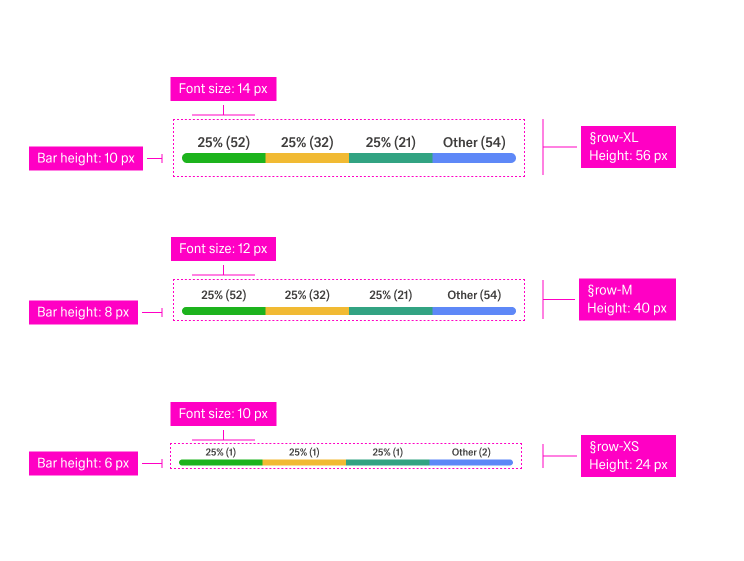
| Height (Relaxed / Relaxed_tooltip) | XS: 24 px · M: 40 px · XL: 56 px | 56 px (XL) |
| Height (Compact / Compact_Tooltip) | XS: 24 px · M: 40 px · XL: 56 px | 56 px (XL) |
| Width (Relaxed / tooltip variants) | 350 px fixed | 350 px |
| Width (Compact variants) | 250 px fixed | 250 px |
| Progress bar track height | XS: 6 px · M: 8 px · XL: 10 px | 10 px (XL) |
| size | XS / M / XL | XL |
Structure
- Row Cell background — full-bleed white fill that aligns the bar with the parent table row.
- Progress Capsule Bar container — horizontal flex container that stretches to fill the cell padding area.
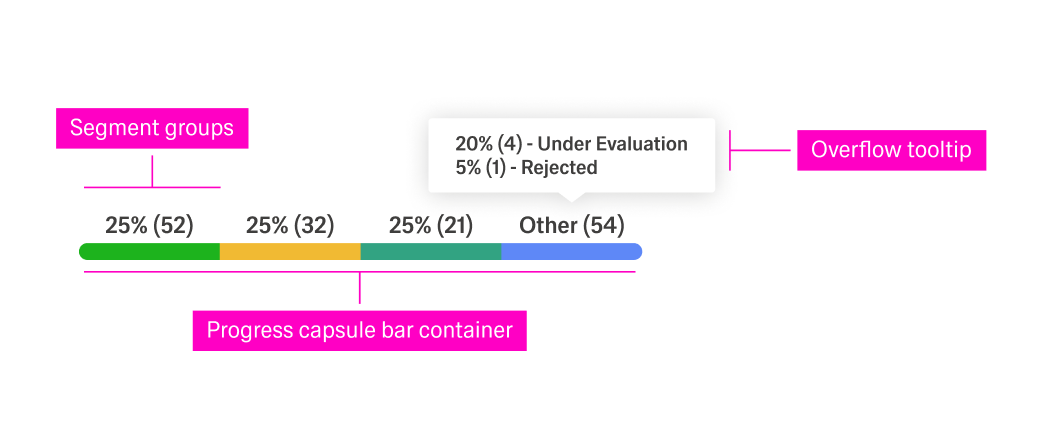
- Segment groups — one flex child per visible status, each containing an optional text label above and a colour-coded capsule bar below. The first segment uses rounded-left caps; the last uses rounded-right caps; middle segments are flush.
- Tooltip (optional) — an tooltip positioned absolutely above the last segment; appears for
Relaxed_tooltipandCompact_Tooltiptypes to surface the 4+ breakdown detail.
(Configured in General Properties)
- displayName — Sets the label shown in the structure panel. For example,
"Pipeline Status Bar"makes the component easy to identify when multiple rows share the same template.
(Configured in Visual Properties)
- size — Controls the overall height of the bar and the font size of segment labels. For example, setting to
"XS"renders a 24 px row-height bar with 10 px (body-00) labels, suitable for dense data tables."M"uses 40 px height with 12 px labels, and"XL"(default) uses 56 px with 14 px labels. - type — Controls whether percentage and count labels are shown and whether a tooltip is attached to the final segment.
"Relaxed"displays labels above each segment;"Compact"hides all labels for a pure-bar view;"Relaxed_tooltip"and"Compact_Tooltip"additionally render an overflow tooltip on hover for the 4+ status group. - visibleStatus — Specifies how many status segments are rendered simultaneously.
"None"shows an empty grey track (0 % state);"2"renders two segments (green + blue);"3"adds an amber segment;"4"adds a teal segment;"4+"adds a grey overflow segment for uncategorised items. - paddingClass — Configures spacing around the component using CSS utility classes. For example,
"px-2"gives horizontal breathing room without changing the bar's internal proportions.
(Configured in Non-Visual Properties)
- segmentData — Provides the percentage, absolute count, colour, and label text for each segment. For example,
[{ pct: 50, count: 55, color: "lime-04", label: "Approved" }, ...]drives the proportional width and tooltip text for each capsule.
Tooltips
(Configured in Non-Visual Properties)
- tooltip trigger — The overflow tooltip (visible for
Relaxed_tooltip/Compact_Tooltiptypes) is rendered via the ADK Tooltip component. It is positioned absolutely above the last segment and is shown by the host application's hover/focus logic — no additional event wiring is required inside the Status-bar itself. - tooltipContent — Sets the multi-line text rendered inside the overflow tooltip for the 4+ variant. For example,
{"en-US": "20% (4) - Under Evaluation\n5% (1) - Rejected"}surfaces the breakdown of the overflow bucket.
Styling
The component uses a fixed colour palette drawn from GE chart tokens. Segment colours are driven by visibleStatus position:
| Segment position | Colour token | Hex |
|---|---|---|
| 1st (always present) | generic/chart/lime-04 | #1db31d (green) |
| 2nd | generic/chart/blue-04 (via asset) | Blue |
| 3rd | generic/chart/yellow-01 | #f1ba33 (amber) |
| 4th | generic/chart/green-04 | #32a382 (teal) |
| 4+ overflow | theme-20 grey track (tooltip variant) | #e7e6e6 |
| Empty / None state | generic/theme/theme-20 | #e7e6e6 (grey) |
(Configured in Visual Properties)
- paddingClass — Adds CSS spacing around the outer container. For example,
"px-2"gives horizontal breathing room without changing the bar's internal proportions.
Actions & Variants
(Configured in Event Actions Properties)
- events — Configures the events the component can trigger and respond to:
- ON_INIT — Triggered when the component is initialized. Use to fetch segment data and populate
segmentDatabefore the row renders. - ON_DESTROY — Triggered when the component is removed from the DOM. Use for cleanup, such as cancelling pending data requests.
- ON_INIT — Triggered when the component is initialized. Use to fetch segment data and populate
Authorization
(Configured in Authorization Properties)
- visibilityPolicySetId — Determines the visibility of the component based on specified policy sets. For example, setting to
"analyticsViewerPolicy"ensures the progress bar is only visible to users with analytics-view permissions.
Tests
(Configured in Testing Hooks Properties)
- dataTestId — Sets the testing hook ID for automated testing. For example,
"row-status-bar-test"lets test scripts reliably target the component regardless of surrounding markup changes. - enableAsHotspot — Enables the component as a guided tour hotspot. When enabled, the bar can be highlighted during onboarding flows to explain pipeline status at a glance.
- guidedTourHotSpotTitle — Sets the title for the guided tour hotspot, supporting translations. For example,
{"en-US": "Pipeline Status", "de-DE": "Pipeline-Status"}. - guidedTourHotSpotDescription — Sets the description for the guided tour hotspot, supporting translations.
Links
- Figma: GE Astronaut Design System — Status Breakdown Bar
- Live style guide:
Guidelines
Usage
- Use the Status Breakdown Bar inside table rows to summarise the distribution of item states; set
visibleStatusto match the number of distinct states your data model produces. - Choose
type: "Relaxed"when the table has enough row height for labels and users need precise percentage and count values at a glance. Choose"Compact"for dense tables where colour alone is sufficient to communicate relative proportions. - Add
type: "Relaxed_tooltip"or"Compact_Tooltip"whenvisibleStatusis"4+"so that overflow categories remain discoverable without cluttering the row. - Always populate
segmentDatafrom the same data source that drives the parent list or table — never derive segment widths from independent API calls per row. - Set
visibleStatus: "None"for rows where the status has not yet been assigned; the grey empty track communicates pending state without showing misleading zeros.
Sizing & Layout
- Match
sizeto the row height of the parent table: use"XS"(24 px) for compact data grids,"M"(40 px) for standard tables, and"XL"(56 px) for wide-format or dashboard tables. - Do not override the fixed widths (350 px Relaxed / 250 px Compact) with custom CSS — segment proportions are calculated relative to these fixed containers and will break at other widths.
- Use
paddingClassto add horizontal breathing room inside the cell; do not apply external margins directly to the component root. - In
XLRelaxed mode each segment label usesbody-02(14 px SemiBold); inMit usesbody-01(12 px); inXSit usesbody-00(10 px). Do not reduce font sizes below these values.
States & Feedback
- Use
visibleStatus: "None"to represent a row where no status data is available — the grey track communicates an empty state without rendering phantom segments. - When transitioning from one status count to another, update
visibleStatusandsegmentDatatogether in a single state change to avoid a visual flash of mismatched segment count and data. - Pair the tooltip (
Relaxed_tooltip/Compact_Tooltip) with a meaningfultooltipContentvalue; an empty tooltip renders a blank pop-over on hover.
Visibility & Authorization
- Gate visibility with
visibilityPolicySetIdfor tables where status detail is restricted to certain roles (e.g., managers only). - Use
displayConditionsto hide the bar in row templates where a progress breakdown is not applicable, such as header rows or group-level aggregation rows.
Content & Localization
- Segment labels are derived from
segmentDataand should be locale-formatted before being passed to the component — the component itself does not apply locale-aware number formatting. - Tooltip text (
tooltipContent) supports i18n objects; always provide at minimumen-USandde-DEkeys.
Dos & Don'ts
| Do | Don't |
|---|---|
Set visibleStatus to match the exact number of distinct states in your data model | Hard-code visibleStatus: "4+" when your data never produces more than 3 states — unnecessary segments confuse users |
Use type: "Compact" in dense tables where row height is limited and colour coding alone is sufficient | Use type: "Relaxed" in rows shorter than 40 px — labels will clip or overflow |
Always provide tooltipContent when using Relaxed_tooltip or Compact_Tooltip to explain the overflow bucket | Leave tooltipContent empty for tooltip variants — a blank tooltip undermines user trust |
Show visibleStatus: "None" for rows awaiting status assignment | Render a zero-value bar for unassigned rows — a grey empty track communicates pending state more accurately |
Match size consistently across all rows of the same table | Mix size values within a single table — inconsistent row heights break visual rhythm |
Accessibility
- Provide descriptive segment labels via
segmentData[n].labelso that assistive technologies can announce each status category by name rather than only by colour or percentage. - Never rely on colour alone to convey segment meaning — ensure that percentage and count values in
segmentDataare always visible (type: "Relaxed") or exposed via a tooltip (Relaxed_tooltip) for users who cannot distinguish chart colours. - In
Compactmode, where labels are hidden, add an ARIA label or title attribute at the container level summarising the overall status distribution for screen-reader users. - Ensure the overflow tooltip is keyboard-accessible: the last segment should be focusable and the tooltip should appear on both
focusandhoverevents. - Use
dataTestIdto expose a stable selector for automated accessibility audits (e.g. axe-core integration in CI pipelines). - Maintain the minimum 6 px bar track height even at
XSsize to ensure sufficient colour contrast surface area — do not reduce the track below this value.